Namespaces, Linking & Two-Gate ACL
Isolate memory per repository by default, bridge multi-repo architectures with Persistent Linked Namespaces, and enforce least-privilege access across agents using Two-Gate Namespace ACLs.
How Sulcus Resolves Namespaces
Request or Env Scope
Per-call namespace arguments, X-Namespace headers, sulcus mcp-proxy --namespace, or SULCUS_NAMESPACE take top priority.
Auto-Detected Repo Scope
IDE and CLI plugins derive a deterministic namespace from your Git repository name (for example checkout-web or payments-rails), falling back to namespace in sulcus.ini or default.
The "global" Namespace
Memories stored in global hold organization-wide engineering mandates and standing preferences that apply across every workspace.
Persistent Linked Namespaces
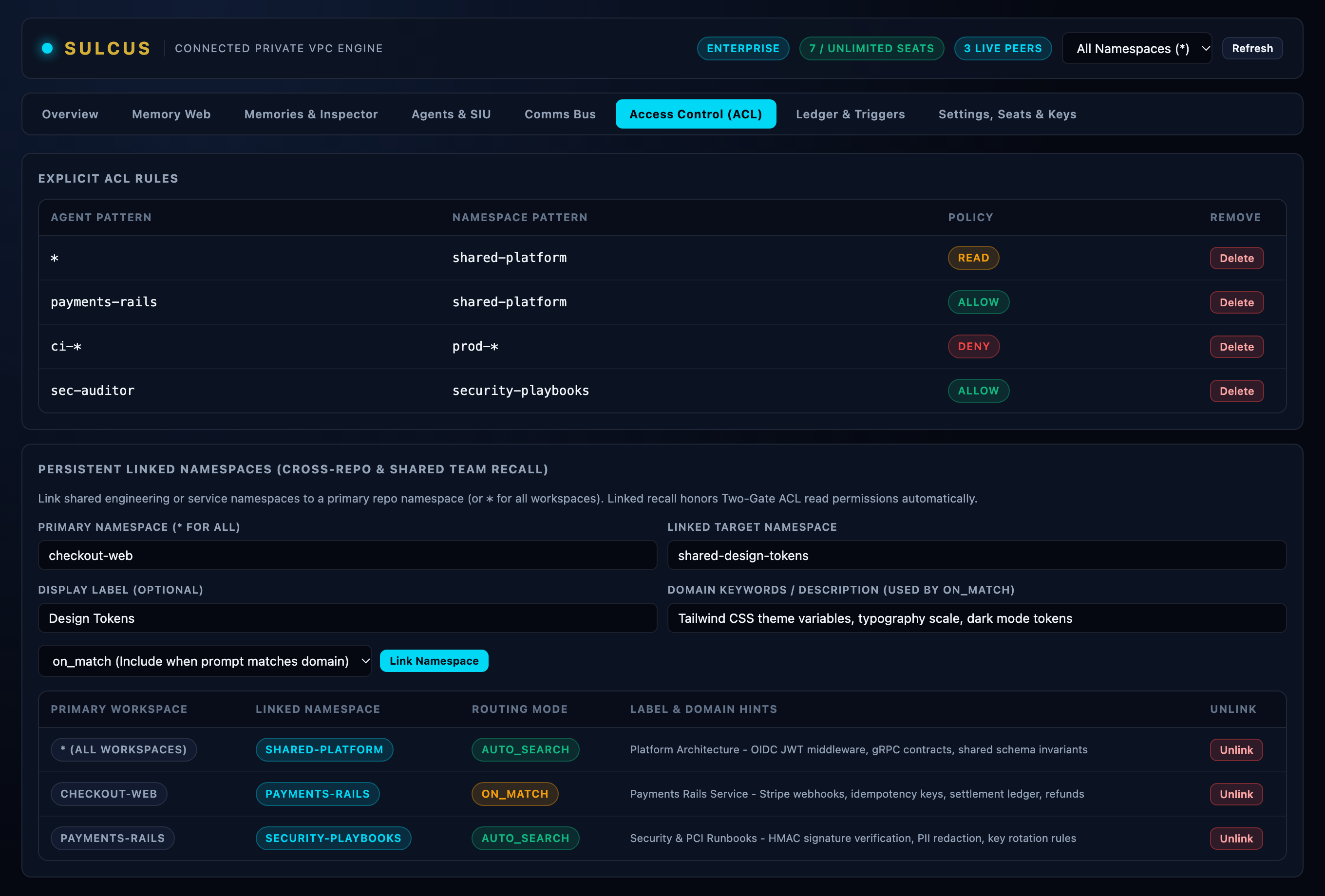
Includes the linked namespace in every default recall and hot-context query from the primary workspace. Best for foundational platform contracts, authentication libraries, and security runbooks that apply on every turn.
Activates only when the user prompt or search query matches the linked namespace slug, its display_label, or any meaningful domain keyword in its description (generic words like repo, service, or api are filtered out so unrelated prompts stay clean).
# List active namespace links visible to your workstation
sulcus namespace list

# Always include shared-platform architecture in recall across every repo (*)
sulcus namespace link shared-platform --all --mode auto_search \
  --label "Platform Architecture" \
  --desc "OIDC JWT middleware, gRPC contracts, shared schema invariants"

# Conditionally pull payments-rails memories into checkout-web only when prompts match
sulcus namespace link payments-rails --primary checkout-web --mode on_match \
  --label "Payments Rails Service" \
  --desc "Stripe webhooks, idempotency keys, settlement ledger, refunds"

# Remove a persistent link
sulcus namespace unlink payments-rails --primary checkout-web# Upsert a persistent namespace link via REST
curl -X POST https://api.sulcus.ca/api/v1/namespaces/links \
-H "Authorization: Bearer $SULCUS_API_KEY" \
-H "Content-Type: application/json" \
-d '{
"primary_namespace": "checkout-web",
"linked_namespace": "payments-rails",
"mode": "on_match",
"display_label": "Payments Rails Service",
"description": "Stripe webhooks, idempotency keys, settlement ledger, refunds"
}'MCP System Instructions (<sulcus-namespaces>)
When an agent connects over MCP, Sulcus injects an ACL-filtered <sulcus-namespaces> block into the MCP initialize instructions so the model knows which peer repositories are linked and can target them explicitly when needed:
<sulcus-namespaces primary="checkout-web">
  <linked namespace="shared-platform" mode="auto_search" label="Platform Architecture">
    OIDC JWT middleware, gRPC contracts, shared schema invariants
  </linked>
  <linked namespace="payments-rails" mode="on_match" label="Payments Rails Service">
    Stripe webhooks, idempotency keys, settlement ledger, refunds
  </linked>
</sulcus-namespaces>Two-Gate Namespace ACL
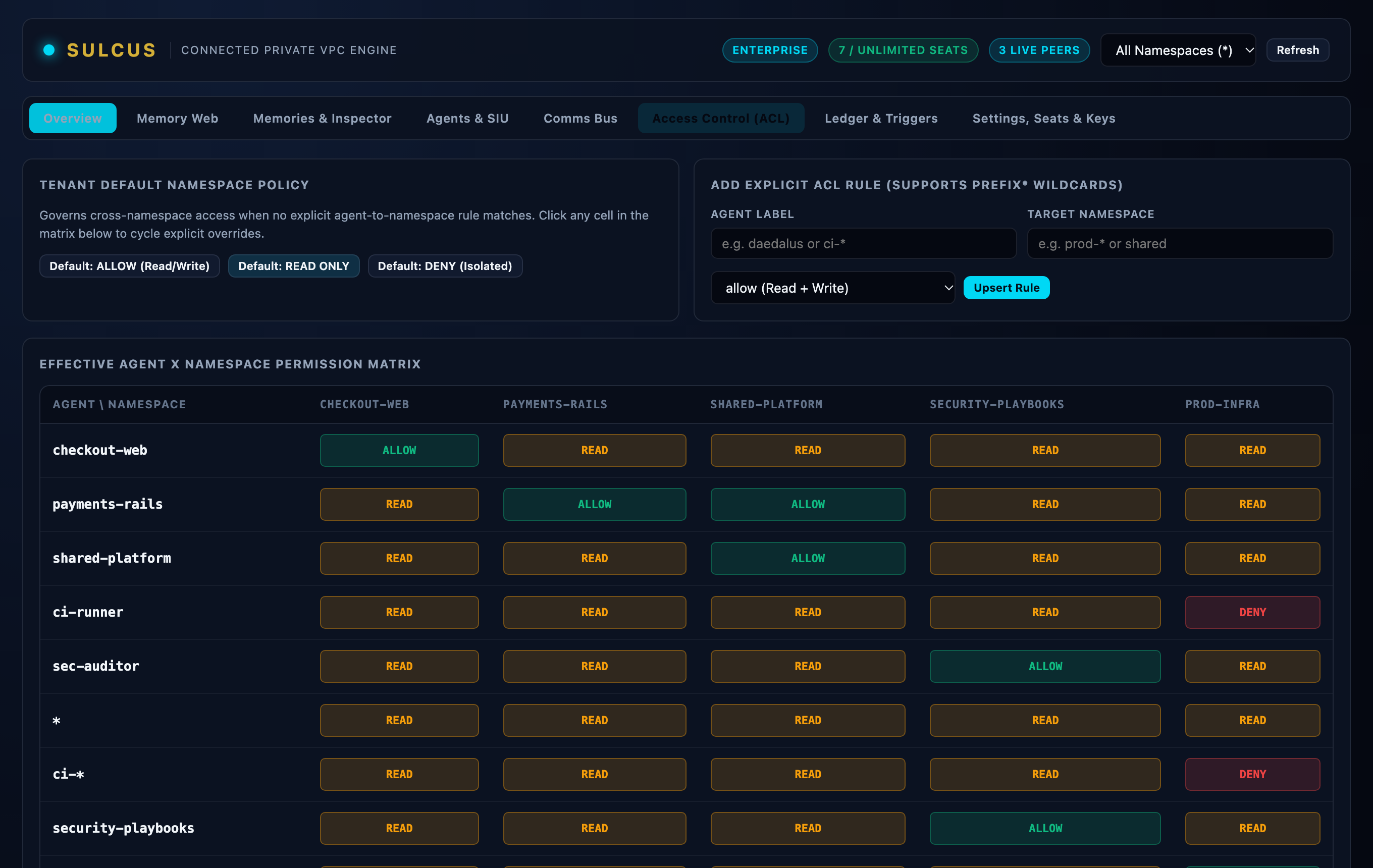
Read / Write / Deny Enforcement
- allow: Full read and write access (memories, graph edges, triggers, bus broadcasts, and ledger).
- read: Read-only recall, graph traversal, and bus subscription. Any write attempt returns
403 Forbidden. - deny: Zero access. Cross-namespace reads and subscriptions return
404 Not Foundrather than403so unauthorized agents can't probe whether a namespace exists.
Curated Knowledge vs. Raw Episodes
During unlinked peer discovery and wildcard prefix searches (such as namespace: "eng-*"), Gate 2 restricts cross-namespace results to durable archetypes: fact, procedural, preference, semantic, and synthesis. Raw episodic session turns are never exposed across unlinked peer discovery, even when pinned. Explicitly linked namespaces bypass Gate 2 because an administrator intentionally paired those workspaces.
Scoped Namespace cannot modify ACL rules, change the tenant default policy, or create tenant-wide (*) namespace links. Calls to POST /api/v1/namespaces/acl, DELETE /api/v1/namespaces/acl/:id, and PUT /api/v1/namespaces/default with an agent-scoped key always return 403 Forbidden.ACL Specificity & Evaluation Order
| Order | Matching Rule | Result | Behavior |
|---|---|---|---|
| #0 | Unscoped Org Key or Human OIDC Session | allow (full tenant read + write) | Organization-level keys without a bound namespace and human Studio/Control Panel sessions can administer all tenant namespaces. |
| #1 | Exact (agent_label, namespace) Rule | Explicit rule policy | Highest specificity override for an exact agent slug and exact target namespace. |
| #2 | Agent Own Namespace | allow | An agent always retains read/write access to its own bound namespace unless explicitly overridden at Rank 1. |
| #3 | Exact agent_label + Prefix/Wildcard Namespace | Longest prefix wins | Matches rules such as payments-rails -> prod-* before payments-rails -> *. |
| #4 | Prefix/Wildcard agent_label + Target Namespace | Ranked by (agent_spec, ns_spec) | Matches team or CI patterns such as ci-* -> prod-* or eng-* -> shared-*. |
| #5 | Implicit "global" Read Fallback | read (when default_policy is deny) | The tenant "global" namespace stays readable for organization-wide conventions unless explicitly denied. |
| #6 | Tenant Default Policy | allow | read | deny | Configured via PUT /api/v1/namespaces/default (defaults to "allow" on new tenants). |
# 1. Set tenant-wide default cross-namespace policy ("allow" | "read" | "deny")
curl -X PUT https://api.sulcus.ca/api/v1/namespaces/default \
  -H "Authorization: Bearer $SULCUS_API_KEY" \
  -H "Content-Type: application/json" \
  -d '{"default_policy": "read"}'

# 2. Block all CI runner keys (ci-*) from reading or writing production namespaces (prod-*)
curl -X POST https://api.sulcus.ca/api/v1/namespaces/acl \
  -H "Authorization: Bearer $SULCUS_API_KEY" \
  -H "Content-Type: application/json" \
  -d '{
    "agent_label": "ci-*",
    "namespace": "prod-*",
    "policy": "deny"
  }'

# 3. Grant payments-rails read + write access to shared-platform
curl -X POST https://api.sulcus.ca/api/v1/namespaces/acl \
  -H "Authorization: Bearer $SULCUS_API_KEY" \
  -H "Content-Type: application/json" \
  -d '{
    "agent_label": "payments-rails",
    "namespace": "shared-platform",
    "policy": "allow"
}'Namespace & ACL Endpoints
/api/v1/agent/namespaces/api/v1/namespaces/links/api/v1/namespaces/links/api/v1/namespaces/links/:primary/:linked/api/v1/namespaces/acl/api/v1/namespaces/acl/api/v1/namespaces/acl/:id/api/v1/namespaces/default